
No time for fancy intros today! You’ve seen the first 40. Let’s just get right to next 40! Take it away, nerds:

The 90 Best Songs of the 90s (Part 1)
We here at SportsAlcohol.com can get down with a good list, but we’ve never attempted one quite so expansive before: a list not just of a band’s best songs, but the best songs of an entire decade: the ’90s, which have been experiencing a major nostalgia boom over the past five years or so, and which we hope to cash in on in a major way with this very undertaking; we just haven’t worked out the specifics of how that will work. In the meantime, you can send us personal checks.
While we wait for those to clear, let me reiterate: yes, this is the biggest list project yet undertaken by this organization. As it turns out, though, even a big list of 90 songs can feel too short when you’re dealing with a whole and particularly eclectic decade. Over 500 songs received votes, and plenty of favorites were left off the final list. Participants were asked to send their ranked lists of the 40 best songs of the ’90s, and the votes (weighted by ranking) were diligently counted in Excel to come up with the list that kicks off today. No adjustments were made for any reason beyond math. No fudging the rules to include a song by a particularly important artist or to cut down on the number of songs by an over-represented ones. This is the list of 22 children of the ’90s, though many of us approach that designation from different ages, directions, and backgrounds.
Today we’ll unveil songs 90 through 51. Tomorrow, we’ll hit 50 through 11. And on Thursday, we’ll get to the top ten. Look for other Best Songs of the ’90s content on SportsAlcohol.com all week, including our biggest podcast ever where a bunch of us got together to hash out this list.
And before we get started on list itself, I’d like to introduce your Best Songs of the ’90s voters. The panel included beloved SportsAlcohol.com mainstays, editors, and contributors whose biographies and past contributions are available at the click:
Chris Adams
Sara Batkie
Jeremy Bent
Jason Forman
Jesse Hassenger
Craig Iturbe
Rob Kuczynski
Marisa LaScala
Sabrina Lauzon
Bennett Morrison
Nathaniel Wharton
Plus these great people I’ll introduce here:
Shelly Casper is an artist, photographer, and teacher.
Sara Ciaburri is a librarian and former DJ.
Kerry Cullen is a fiction writer and editorial assistant.
Derrick Hart is a music fanatic and librarian from Boston by way of Upstate New York.
Michelle Paul is Director of Product Development at Patron Technology.
Lorraina Raccuia-Morrison edits textbooks and makes pottery.
Cristin Stickles is a book buyer for McNally-Jackson who makes New Jersey look good.
Erin Styne is a teacher and mother.
Alex Templeton is a middle school teacher, voracious reader, and writer in Philadelphia.
Bayard Templeton is a teacher, Mets fan, and theater enthusiast.
Jennifer Vega is a birder, administrator, and Mariah Carey scholar.
I am especially proud of two things about our contributors:
1. The gender makeup is majority female.
2. None of us are professional music critics.
Now then:
The 90 Best Songs of the 90s (Part One of Three)

Dana from Morphine is sitting 4 feet away from me…
[ed. note: chris sent me this email years ago and I asked that we be allowed to publish it as part of our ’90s music rundown because it is the best email I’ve ever received]
Dana from Morphine is sitting 4 feet away from me…
at a cafe.
I see Dana from Morphine all the time.
Dana from Morphine is a carpenter or fix-it dude of sorts.
He does work at the bookstore that my boss owns.
He drives a pick up truck with assorted band stickers on the back.
It is parked outside my office building all the time.
One of the stickers is a Twinemen sticker.
The Twinemen suck.
Compared to Morphine, at least.
duh.
My office is on the fourth floor.
On the fifth floor is Hi n Dry studios.
Morphine recorded and hung out there all the time.
Various Dana from Morphine related projects record there still.
Sometimes i can hear Dana from Morphine playing the saxamaphone.
Often the same thing over and over again.
For a long time.
That is what recording is all about.
The saxophone carries, so often that’s all i can hear.
wahwahwah, through the ceiling.
Sometimes i pass Dana from Morphine on the loading dock.
Or the stairs.
And i say “hi”,
like he’s not Dana from Morphine,
and he’s just some dude, that plasters ceilings,
carrying a baby car seat,
and i think about telling him that i was way way into Morphine.
That when i was, like, 15,
Morphine, was, like, my fourth favorite band,
between, like, TMBG and Weezer.
That i remember exactly where i was,
and what i was doing,
when i heard that Mark Sandman was dead.
But i think about all that for a sec,
and that he’s got a baby carrier,
and ‘hi’ will have to do.

Top 6 90s Soundtrack Albums Featuring Elastica
I spent a lot of time preparing for our top songs of the ’90s list by just trying to remember all the songs I heard in the ’90s. Unlike when I put together a list of my favorite songs of the ’00s, I couldn’t just consult my iTunes/last.fm history. With CDs often priced in $15-20 range, teenagers like me in the pre-mp3 ’90s absorbed music through a disparate collection of sources: the radio, MTV, going to shows, browsing record stores, and many, many tapes (be they mixed, dubbed, or recorded from the radio).
One of the most popular delivery methods of popular music in that bygone era was the movie soundtrack album. While some movies still market soundtracks like they did back then (YA movie adaptations spring to mind), they definitely aren’t the original popular music delivery system they were back in the day. The episode of Parks & Rec where Millennial April is disdainful of Gen-Xer (and avowed Letters to Cleo fan) Ben’s collection of soundtracks on CD wounded me to my core.

I wanted to write something authoritative about how special soundtracks could be in the ’90s, but this list is the most I’ve ever agreed with a list on the internet that I didn’t contribute to. I didn’t want to be redundant, so I decided to narrow my focus a little, to just soundtracks featuring the band Elastica.
Why Elastica? To me this group of (mostly) women who kicked out late-70s/early-80s-style post-punk blasts of sound a decade before it was trendy again were the coolest band on earth in the ’90s. They also happened to show up on soundtrack albums as much as anyone else in the ’90s, and I wanted to celebrate them because none of their songs made our list of the top 90 songs of the 1990s.
This list only includes soundtracks where Elastica is included on the album. It was always annoying when a song appeared in a movie but not on the soundtrack and vice versa, but that’s a rant for another time. The albums are ranked on three criteria, weighted on a case-by-case basis according to my whimsy:
- How good the movie is
- How good the Elastica song is
- How good the rest of the soundtrack is

6. Nowhere (1997)
What is this movie?
Wikipedia says it’s the final chapter of director Gregg Araki’s “Teenage Apocalypse Trilogy.” The box cover says it’s “90210 on acid.” I literally just discovered it existed when putting together this list so that’s all I got.
How is it?
I haven’t seen it, but if Akari’s other Teenage Apocalypse films are as unfunny, bleak, and heavyhanded as The Doom Generation (which I have seen), I’m in no rush. The trailer seems to confirm my suspicions.
What is the Elastica song?
“In The City” which as far as I can tell first appeared on this soundtrack. Unfortunately, the pile of scholarly research about Elastica I was hoping to reference for this piece doesn’t actually exist so I can’t be sure.
How is it?
It’s pretty good! Clocking at a tight 90 seconds, this ditty about ambivialance over a potential relationship would be right at home on Elastica’s classic self-titled debut. Points off because I was kind of hoping it was a cover of The Jam song with the same name. As much as I like Elastica, the Jam song is better.
How is the rest of the soundtrack?
Like a lot of compilations, it’s a mixed bag. Hole’s atonal, anti-rape culture screed “Dicknail” reminds me of when Morrissey plays “Meat is Murder” live in the sense that it’s both preaching to and turning off the choir at the same time. There’s also a 311 song that sounds like a parody of a 311 song and a Daft Punk remix of a Chemical Brothers song that’s so boring I don’t believe either group was actually involved. Bright spots include some dreamy-sounding tracks by Catherine Wheel and Lush as well as a Chuck D solo joint that’s a few years ahead of its time.

5. Suburbia (1997)
What is this movie?
Richard Linklater’s adaptation of Eric Bogosian’s play of the same name. It follows a group of (you guessed it) slackers over (you guessed it) the course of a single night. For the movie, Linklater transplanted the action to a suburb of (you guessed it) Austin, Texas.
How is it?
I don’t know! I feel kind of bad about my glib description above, but it’s interesting to remember there was a time when Linklater was a promising young filmmaker and not the acclaimed auteur he is today. It’s also weird how the director who made Boyhood made so many movies before that take place over the course of 24 hours or fewer. I’m trying to say I haven’t seen this or very many of Linklater’s films in general and I’m trying obfuscate that fact by making fun of him. This one isn’t entirely on me as the film is not widely available. It’s never been released on DVD or Blu-Ray. However, I am more familiar with Bogosian’s work on Law & Order than I am with his plays, so there’s a strong case to made that I’m the problem.
What is the Elastica song?
“The Unheard Music,” a cover of an X song featuring Pavement’s Stephen Malkmus
How is it?
So freaking good! Despite the fact that Malkmus and Elastica frontwoman Justine Frischmann retain the original’s boy/girl vocal interplay and melody, it sounds like an entirely different (and much more interesting) song. One awkward trivia tidbit about Elastica is that they were accused of plagiarism more than once by bands that obviously influenced them, like The Wire. However, I always thought what they did was different enough to constitute original work. It’s interesting here to hear them strip away X’s rockabilly roots and replace it with Wire-style robotic noise. Also, it reminds of my favorite songs on The Menace, Elastica’s underrated second (and final) album.
How is the rest of the soundtrack?
It might be good. Like the movie itself, it’s surprisingly hard to find. It doesn’t seem to be digitally available anywhere. Like, you can’t buy it on iTunes or the Amazon MP3 store, let alone stream it. Sonic Youth scored the film so there are a bunch of their songs in addition to Beck, Superchunk, and other things you would expect to find on there. A definite strike against the album is the cover, which is the only one on the list to not have the names of the bands. That was always an important piece of information when making soundtrack purchase decisions.

4. Mallrats (1995)
What is this movie?
Kevin Smith’s followup to his classic no-budget debut Clerks (which almost received an NC-17 rating for its bawdy dialogue) follows some aimless twentysomethings as they try to win their girlfriends back during a hi-jinks filled day at the mall.
How is it?
I don’t know, but not because I haven’t seen it. I loved this movie as a teenager so much it felt like it was made for me. But much like my own attitudes and brand of humor from that era, I worry that Smith’s movies are a little on the juvenile side and haven’t aged well. I’m afraid to rewatch them and have them tarnish my memories.
What is the Elastica song?
“Line Up,” the first track from their self titled debut
How is it?
It’s great, but there’s not much to say about a song you already know.
How is the soundtrack in general?
Not bad! Like the movie itself, I had a lot of trouble properly rating this one. It is strangely, almost equally, divided between previously released songs (like “Line Up”) and brand new tracks. New songs included an OK Bush song, a pretty good Belly ballad, and “Suzanne” by Weezer. “Suzanne” is not the best Weezer song of the ’90s (according to our list), but with its Beach Boys harmonies, crunchy guitars, and soaring solos, it may be the platonic ideal of a Weezer song.
The Mallrats soundtrack also had the very ’90s feature of breaking up the songs with tracks of dialogue from the movie. I consider this a plus.

3. Dead Man On Campus (1998)
What is this movie?
MTV Films’ attempt at a National Lampoon/American Pie style comedy with their first R-Rated feature. Mark-Paul Gosselaar and Tom Everett Scott play college freshman who try to find a third roommate to commit suicide so they don’t fail all their classes.
How is it?
It’s bad! In the next entry I will refer to The Craft as good for what it is. Dead Man On Campus is not even good for what little it is. I think I laughed at one joke. While I was surprised to find Gosselaar had actual comic timing, there are so many bad performances from actors I generally like that I assume the director is to blame. Reread my plot synopsis. It’s actually dumber than that if you watch the whole thing. This movie’s release was timed with the start of the college school year, specifically right when I went to college for the first time. This was aimed right at me and missed completely. This is all compounded by the fact that as an MTV film, it was the recipient of of a large cross-promotional effort that was inescapable if you watched MTV at all.
What is the Elastica song?
“Human,” which would later show up on The Menace
How is it?
I feel like I’m not qualified to say. This came out during the five-year gap between Elastica’s only studio albums, so I was hungry for any Elastica at that point. It was dark, mid-tempo, over three minutes long, and introduced some new textures to their sound, so it showed some growth for the band.
How is the rest of the soundtrack?
About as good as a compilation with a Creed song can be. It was exec-produced by The Dust Brothers and put out by DreamWorks. This lead to some interesting choices like including songs by Self and Creeper Lagoon (two bands I loved at the time, but never got their due). I actually like Marilyn Manson’s cover of David Bowie’s “Golden Years.” This came out right around Mechanical Animals, which also sported a noticeable 70s Bowie influence. What I’m trying to say is that there were a few months in 1998 where I kind of liked Marilyn Manson. The highlight of the soundtrack for me is Blur’s “Cowboy Song,” where Damon Albarn and Graham Coxon give into to some of their worst musical instincts (falsetto, slide guitar) but come up with a genuinely fun song. Bonus points to whomever at DreamWorks thought it would be cute to put former couple Frischmann and Albarn’s bands back to back on the tracklist.

2. The Craft (1996)
What is this movie?
A supernatural thriller about teen girl outcasts who become witches to deal with problems of adolescence but end up turning on each other.
How is it?
Good for what it is: a campy romp. Fairuza Balk gets a career-defining role. It plays as much as a superhero movie as it does a horror film. If that sounds like your type of thing, you would probably enjoy it. I do fear, however, that people who loved it growing up now overestimate how good it is in adulthood (much like another movie of the era starring Robin Tunney and having a memorable soundtrack, Empire Records).
What is the Elastica song?
“Spastica,” a B-side from the “Connection” single
How is it?
It’s a B-side for a reason. A pretty cool chorus without many lyrics, a pretty cool bass line, and some digs at a guy. Kind of a by-the-numbers Elastica song, but not fully baked. It would have been a weak point if it was included on one of their albums. Also, maybe just don’t use the word ‘spastic’ in this day and age unless you’re referring to very specific medical conditions.
How is the rest of the soundtrack?
Underrated! I don’t know why I don’t hate Love Spit Love’s cover of “How Soon Is Now” like most Smiths fans, but I enjoy it! I even enjoy Our Lady Peace’s cover of “Tomorrow Never Knows.” I even enjoy Our Lady Peace’s cover of “Tomorrow Never Knows.” That is not a typo; that sentence is there twice for emphasis. Letters to Cleo and Heather Nova also do surprisingly not-bad covers. It’s rounded out by a very ’90s list of artists including Jewel, Matthew Sweet, and Tripping Daisy.

1. Trainspotting (1996)
What is this movie?
Danny Boyle’s pitch black comedic adaptation of Irvine Welsh’s classic novel about a group of ‘friends’ in Edinburgh who use any vice (but mostly heroin) to fill the void.
How is it?
A testament to how good this film is: I sometimes faint when having blood drawn, but I will watch this movie full of graphic depictions of people shooting up heroin at least once a year. Funny, well-acted, inventive, and real, it’s amazing how rewatchable a film with such dark subject matter is.
What is the Elastica song?
“2:1,” from their self-titled debut.
How is it?
It’s good, but notable for being maybe the only downtempo Elastica song from their early period. Also, it’s a bit of a bummer that this is a reused album track as opposed to something new. That being said, it perfectly scores a montage in the back half of the film.
How is the soundtrack in general?
Would it be hyperbole to say it is the most culturally significant movie soundtrack since Saturday Night Fever? Yes, but I’m saying it anyways. It was instrumental to popularizing britpop outside of Britain. The inclusion of “Lust For Life” introduced Iggy Pop the musician to a generation that just knew him as Nona Mecklenberg’s father on The Adventures of Pete and Pete. Unlike a lot of soundtracks of the time, the songs were really used as score and it was done to perfection.

Rest of the 1990s Track Marks: “Rebirth of Slick (Cool Like Dat)” by Digable Planets
Starting next week, we’ll unveil our big list of the Best Songs of the 1990s. In the run-up to the reveal, we’re featuring some of our favorite songs that didn’t make the list through our regular Track Marks feature.
When you think of rap in the ’90s, it’s understandable if jazz hip-hop trio Digable Planets doesn’t immediately come to mind. Just a scant few years after they released “Rebirth of Slick (Cool Like Dat)” in 1992, Biggie and Tupac would emerge as pioneers of the genre and the East Coast/West Coast battle would be underway, dominating much of the scene until Jay-Z took up the mantle towards the end of the decade. While the laid-back vibe of the group’s most popular single may have soon found itself out of step with its more confessional successors, who openly mined their own biographies for their biggest hits, the song’s insanely catchy horn hook and dizzyingly dense lyrics have a charm and swagger all their own (and aren’t above some playful boasting: “We be to rap what key be to lock,” Ishmael “Butterfly” Butler asserts at one point, and it’s tough to disagree, at least while the song is spinning.)
I was reminded of the song’s pleasures when it was used in two pieces of popular culture this year: first in the summer’s delightful if uneven indie Dope and then over a montage in David Simon’s masterful HBO miniseries Show Me a Hero. While the use in the first instance is mostly nostalgia-driven given that the plot is about modern high school students whose nerdery is largely based in fetishizing the past, particularly the ’90s, the second has some surprisingly emotional context. Up until that point Hero‘s nondiegetic music had been solely Springsteen and tied tightly to the ostensible hero of the show, Oscar Issac’s baby mayor of Yonkers Nick Wasicsko. But Digable Planets kicks in as the mostly minority housing residents show the white citizens who have been fighting the new construction around their homes in an effort to prove their ability to be good neighbors. It’s a sly move on the part of Simon and company, as it’s conceivable that said residents would be listening to such a track themselves in the same way Isaac’s do-gooder would be obsessed with the Boss. But it also tips its hat to the way black culture was beginning to blend into the popular consciousness, a trend that would continue through the ’90s and beyond.
The song, and group, is also notable for being one of the few rap outfits outside Salt-N-Pepa to showcase a female voice. While the lyrics that Mary Ann “Ladybug Mecca” Vieira spits aren’t gendered, it’s still refreshing to hear her chime in with the same confidence as the boys, particularly since the genre as a whole often does very poorly by women. In the end it’s this sense of togetherness and positivity that makes the song endure beyond its singular groove. Digable Planets never make clear what exactly the “dat” they’re cool like is. Which means it could apply to just about everyone.

REST OF THE 1990S TRACK MARKS: “WHAT’S THIS?” BY DANNY ELFMAN
Starting next week, we’ll unveil our big list of the Best Songs of the 1990s. In the run-up to the reveal, we’re featuring some of our favorite songs that didn’t make the list through our regular Track Marks feature.
When the contributors to our upcoming ’90s list talked about how they put together their individual ballots, it was inevitable that the subject of how many avenues of discovering music there was in the ’90s came up. The radio played songs we wanted to listen to! The TV showed music videos! Just when all of that was starting to fade, we went to college and found the anything-goes world of a fast internet connection hooked up to peer-to-peer filesharing! The world was our musical oyster.
But, when going over the songs that actually made it onto our ballots, one path to discovering new music—one that’s very much still used today—kept coming up over and over: movie soundtracks. We’d discuss a song, then someone would talk about how it was used to perfection in a critical movie scene. I’m sure Rob and Jesse could write a Track Marks post about every single song on the soundtrack to Danny Boyle’s A Life Less Ordinary (see our upcoming podcast for more on this); I myself almost did this post about “A.M. 180” by Granddaddy—which has been my only ringtone since my very first cell phone—a song I first heard in Boyle’s 28 Days Later. (And, you know, non-Boyle soundtracks are pretty good, too.)
But there’s a certain category of movie soundtracks that, while I’m sure we all listened to them on a loop in the ’90s, probably didn’t make it on our individual ballots: animated movie soundtracks. My long list had a few, including “Belle” from Beauty and the Beast and “Be Prepared” from The Lion King. My short list only had one: “What’s This?” from The Nightmare Before Christmas.
It’s one of the only animated-movie soundtrack songs I still listen to today; granted, it’s because I treat it as a Christmas song more than anything else. But the fact that it could have a second life in my annual iTunes Christmas playlist also speaks to its craft—I’m pretty picky about my holiday music. (Sorry, kids from South Park, your holiday songs don’t make the cut because your voices are too irritating.) To me, this one is up there with Vince Guaraldi.
What makes “What’s This?” unique for a holiday song is that it’s about looking at Christmas from the outside. Yeah, our traditions should seem both strange and incredible to an outside observer; seeing Jack Skellington’s awe invites us all to look at the holiday as if it’s our first time.
And then, of course, there’s Danny Elfman. I bet that man could write the instrumentation for 10 perfect Christmas songs in his sleep—he seems like I’d bet he’d want to add sleigh bells to nearly everything, holiday-related or not. It’s a harder hurdle to clear to seamlessly combine the musical aesthetics of Christmas and Halloween, like he does on other songs on The Nightmare Before Christmas soundtrack. But his performance as Jack is what really makes “What’s This?” (I should be ashamed to admit that I’ve only heard Elfman sing through Jack Skellington; my knowledge of Oingo Boingo is nil.) Through his Skellington, we get the excitement of discovery, the wonderment of Christmas, the puzzlement over coming across an unknown culture, and then the burning desire to possess and control it all.
By the end of the ’90s, The Nightmare Before Christmas became shorthand for a certain kind of Hot Topic goth. But they don’t get to own “What’s This?” the way Jack Skellington doesn’t get to own Christmas. It’s ours this time.
https://www.youtube.com/watch?v=ZPblZa10_Pk

Rest of the 1990s Track Marks: “Ruby Soho” by Rancid
Starting next week, we’ll unveil our big list of the Best Songs of the 1990s. In the run-up to the reveal, we’re featuring some of our favorite songs that didn’t make the list through our regular Track Marks feature.
The 1990s was a good decade for taking punk music out of Berkeley, California and selling it to the mainstream kids across the country, all the way to the suburbs of New York (ahem). At the helm were two Armstrongs: Billie Joe of Green Day, and Tim of Rancid. For a while, it seemed like both bands were on the same trajectory: They were from the same neighborhood, signed to the same label (we’ll forget it’s the one that also discovered The Offspring), and both put out breakthrough albums in 1994. But, for whatever reason, Green Day hit first and rocketed to a level of fame that gets its songs onto best-of lists, while Rancid’s songs pick up a few bottom-of-the-list votes that don’t get it onto the final roster.
That’s not to take anything away from Green Day—I definitely had them high up on my final ballot—but, when you listen to “Ruby Soho,” you realize it’s not fair. It has all the makings of a tune that’s not just good for a punk track if you’re into that kind of thing, but a classic, love-it-forever type of song, including:
- Telling a sad story in an upbeat tempo. There’s yearning, there’s leaving, and Ruby is sad, but you can still pump your fist to it.
- It’s a song about music, and making music. He’s leaving because he’s a musician; he loves her, but he sees his name on a marquee and knows he can’t resist.
- The word “Ruby” in the title. As in Tuesday. Musicians from 1996 onward had to really think about naming an in-song character Ruby, since “Ruby Tuesday” and “Ruby Soho” set an almost impossible bar to meet.
- Random evocation of a New York City neighborhood. Even when it comes from Californians, it gives the song mystique. I don’t know much about Ruby Soho, but the name alone makes me think it’s something downtown, underground, cooler than I am, and a little worse for wear.
- Parts that you can split up when you sing in the car. Makes the song equally at home on road-trip mix tapes as it is on romantic mix tapes.
I won’t say that “Ruby Soho” never got its due; it’s on Rancid’s most popular album, …And Out Come the Wolves, and they played it on Saturday Night Live. It’s been covered by Vampire Weekend and Jimmy Cliff. But, as a suburban pre-teen looking to pretend like I was a California punk for two minutes at a time, I would’ve preferred meeting Ruby Soho and hanging out with musicians in the city than chilling with Green Day on their couch, doing whatever it is they were doing in “Longview.”

HALFTIME REPORT: Attack the Block (2011)
With Halftime Report, your good friends at SportsAlcohol.com revisit some of their favorite films from the first half of this decade.
For monster fans, creature design in the 21st century has been something of a mixed bag. Digital animation has freed designers from the shackles of the human form, limitations in terms of textures and fur, and even the bounds of physics altogether. In order to provide a grounding in reality for all these pixels, designers and animators often talk about looking to real animals for physiognomic principles and behavior. Reality is the goal, and much effort is expended in simulating the way joints interact or how skin stretches across muscles. This is maybe best exemplified by Neville Page’s muscly multi-limbed creatures for movies like Cloverfield, Super 8, Avatar, and Star Trek. But these impressively realistic creatures often place an emphasis on the Real over the Iconic. It seems silly to use a word like mundane when discussing such weird and impressive creations, but these creatures (with the feelings of sameness they can sometimes inspire) can miss that special charge that a truly iconic monster design can carry. Obviously, creating an iconic monster is much easier said than done, but it’s still worth celebrating when somebody pulls it off. And the aliens in Attack the Block, with their uncanny movements and simple-but-clever silhouette-and-glowy-bits aesthetic, stand out as the best of the decade so far. Using an inspired blend of suit acting (with invaluable work by movement coach and performer Terry Notary) and animation (both to enhance the puppetry and to create the aliens’ inky black, almost two dimensional look), Attack the Block‘s monsters are still so great they’re nearly enough to make it one of the best films of the 2010s on their own.
But watching the film in 2015 America reveals greater relevance than even a few years ago. The film is set in south London and directly addresses the specific cultural ways that young, mostly black, kids who live in council estate tower blocks (Americans, think housing projects) are vilified, and the societal issues at play are startlingly universal. After the opening, a mugging that wouldn’t be out of place in any reactionary genre movie from decades past, with a gang of black kids menacing a pretty white woman, it’d be easy to imagine the version of the movie that kills off these thugs in a pre-title sequence to establish the threat. Instead, when Moses and his gang run into the building where they’ve cornered a mysterious creature, they aren’t just slaughtered off-screen but instead emerge victorious, establishing a very different dynamic for the rest of the film. Instead of just following the story of the gang’s victim, Jodie Whittaker’s Samantha (a nurse who lives in the same tower block as the kids), the kids emerge as the heroes of the film. Cornish and his actors do a wonderful job of humanizing these characters, making them funny and hugely lovable without ignoring or excusing their worst behavior. This simple extension of empathy and respect feels almost radical when viewed in an America where we’ve had a truly horrible number of opportunities to witness the awful spectacle of the American news media greeting each new police shooting of an unarmed black guy with attempts to determine just how much the deceased had it coming based on their thuggish appearance or potential criminal background. The understanding and mutual respect that develops between Samantha and Moses is even more moving in this context, as is the conversation the kids have speculating about the government having “bred those things to kill black boys.” It’s not the case, but getting to know these kids we can see why it would feel like a possibility to them.
While it feels a little frustrating watching Attack the Block now knowing that Joe Cornish hasn’t yet directed another feature, there’s some solace in seeing ads for Star Wars: The Force Awakens that feature John Boyega front and center. His performance as Moses, which has that movie star thing of combining real acting and seemingly effortless charisma even when he spends so much of the film not saying much, marked him as a young actor to watch for anybody who saw Attack the Block in 2011, so it’s gratifying to know that a much bigger audience is about to see what he’s got.

Another Season of Halt and Catch Fire—Burn to the Ground and Begin Again
There will be spoilers in everything that follows
Thirty years ago this week, Steve Jobs was pushed out of Apple through a series of reorganizations and board maneuvers. Yet one can’t think about that failure outside the context of his second act: Steve Jobs rising again. He spent time at Pixar, created NeXT, got brought and bought back by Apple, and put Apple on the path to being the most valuable company in the world, which it is today. That is one hell of a second chance story. That is a second-chance story that Halt and Catch Fire wishes it could tell. In fact, the season finale of Halt and Catch Fire alluded to Jobs’s Apple exit in a quick cut that was almost easy to miss:
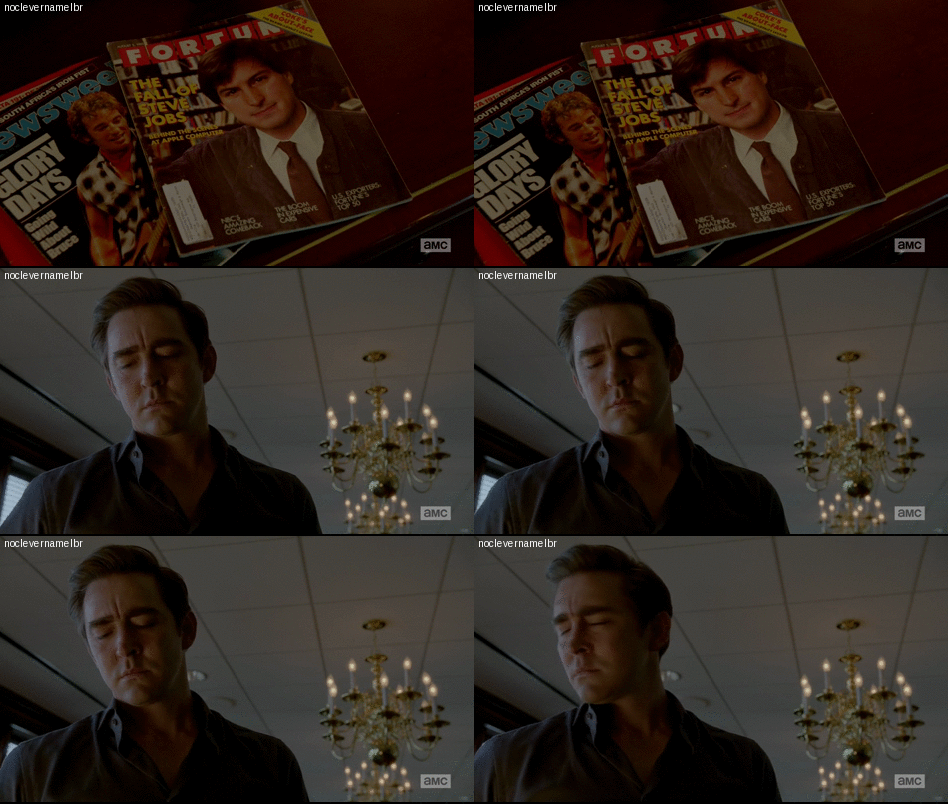
Again, in the near-historical, alternate history of Halt and Catch Fire Apple—the most familiar of tech stories—plays the foil. The series used Apple last season when the introduction of the Macintosh stood in for innovation at a time when the central character Joe (Lee Pace) had just made the profit-driven decision to simply make the machine they were creating faster and cheaper. In contrast, the Macintosh “spoke.” Because Halt and Catch Fire must operate in this bizarre world of almost-real computing history, it nodded to the true history, although never quite hitting the same historical notes in the way that Mad Men could.
The parallels with Apple continue into the second season. Like Steve Jobs’s second act, Halt and Catch Fire Season 2 is a season of second (or third) chances. As it begins, the PC division of Cardiff Electric—the driver of the main story of Season 1— is sold off, making an ignominious end for something that took so many episodes to build. But, with that sale, every character is looking for their next chance.
Having flamed out at IBM and again at Cardiff (quite literally), the Joe is on his third chance when the season begins. He’s more relaxed, more authentic, with less product in his hair. His arc for the season is to see if he can be this authentic, honest person and also the successful visionary that he always been promised to be.
But he’s not the only one with vision. The central characters of the second season are actually Donna (Kerry Bishé) and Cameron (Mackenzie Davis), who struggle to build a company in the world of computers that are connected to phone lines. Apparently, this connected world is going to be big. Their arc is to make the company survive given Camerons no-selling-out ideals and turmoil in both of their personal lives.
And personal lives figure heavily throughout second season, a more conventionally dramatic season than the first. Season 2 has clandestine romances, an engagement, infidelity, a secret abortion, chronic mental diseases that cause amnesia, polyamory, a hate crime, and a marriage. Many critics I’ve read thought Season 2 was the better of the two, and, by conventional measures, they’re probably right. This is a more relationship-focused Halt and Catch Fire. It isn’t about building a company; it was about the people that made up the company.
Yet, missing from Season 2 are the business cases—the narratives about running a company. Yes, there are bad contracts that need to be renegotiated and employees that need to managed, but these were the background to the intense personal drama. Perhaps the narrative most similar to a business case was Cameron’s realization that more customers are interested in online communities than the online game playing she was so interested in creating. From listening to customers, she figures out that the focus of her company is wrong, and she needs to address it. In contemporary startup lingo, that would be the pivot.
Last year I argued that the business cases were a significant reason that Season 1 of Halt and Catch Fire was so interesting, and perhaps, it is the business case of the entrepreneur that so attracted the affluent viewers who made sure there was a Season 2. And, seen in that way, perhaps the most entrepreneurial point of this season is that second, third, and fourth chance. At the end of Season 2, Cameron and Donna are heading out to California as part of the second act of their online company Mutiny, while Joe has secured ten million dollars in funding for Macmillan Utilities, a virus utility company that is reminiscent of Norton Utilities and McAffe. Macmillan Utilities is the result of a virus that is mistakenly designed by his old partner, Gordon (Scoot McNairy)—who sought his own second chance to redeem himself from the slip-ip—and unleashed upon him by Cameron as revenge for a deal gone bad. And, because we live in 2015, we know that these second chances will pan out. As viewers, we know that online communities and computer antivirus will become huge. That’s the comforting thought that the series leaves us with: The next chance might be even bigger than this one. Like, maybe the next Apple.

The SportsAlcohol.com Podcast: Indie Movies of Summer 2015
The SportsAlcohol.com crew has talked about a lot of blockbusters this summer, including Jurassic World, Mission: Impossible – Rogue Nation, Mad Max: Fury Road, and Avengers: Age of Ultron. But there are plenty of other moviegoing options outside of standard multiplex fare, so Nathaniel, Sara, Marisa, and Jesse got together to discuss the wide variety of non-blockbuster independent-type films that played in theaters this summer (and in many cases are still playing, or are available on VOD!). We chatted in beautiful Prospect Park at dusk, so this episode has ambiance to spare as we talk about over a dozen different indie movies.
How To Listen
- We are now up to
SIX (6)
- different ways to listen to a SportsAlcohol podcast:
- You can subscribe to our podcast using the rss feed.
- I’m not sure why they allowed it, but we are on iTunes! If you enjoy what you hear, a positive comment and a rating would be great.
- I don’t really know what Stitcher is, but we are also on Stitcher.
- SportsAlcohol.com is a proud member of the Aha Radio Network. What is Aha? It’s kind of like Stitcher, but for your car.
- You can download the mp3 of this episode directly here.
- You can listen in the player below.